

A stablecoin is a type of cryptocurrency whose value is designed to be stable, holding a steady price. The value is usually tied to a fiat currency like the U.S dollar, which gives stablecoins their stability.
If a stablecoin is pegged to the dollar, that means 1 coin is built to remain worth $1. To maintain that peg, issuers typically rely on a reserve of U.S dollars or equivalent assets as collateral. To sum up, they aim to offer the benefits of cryptocurrency – high speed, low-cost and decentralized transactions – with the stability of traditional assets.
The GENIUS Act, having cleared the U.S Senate, attempts to strengthen the foundation. The Act requires stablecoins to be backed 1:1 by high-quality liquid assets such as Treasury bills and Federal Reserve deposits, mandate anti-money laundering programs, ban interest payment and require regular audits. As a result, stablecoins are gaining newfound legitimacy, making it increasingly important to understand what they do and how they may reshape the investing landscape.
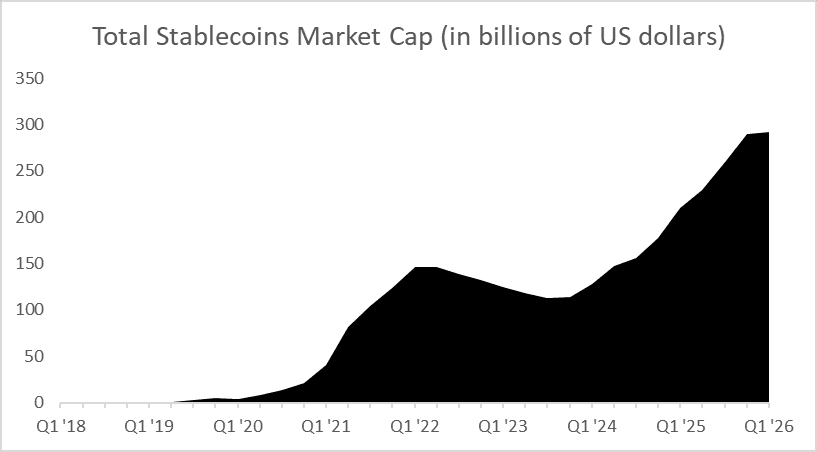
Defillama, Tokenterminal, Statista
Why do stablecoins exist?
How are stablecoins different from other cryptocurrencies?
To understand why stablecoins were created, it helps to look at the world of digital assets they grew out of. They emerged to solve a clear problem in the crypto market: high price volatility. Digital currencies such as Bitcoin and Ethereum have values that can drastically change, where a 10% move in a day might not be cause for concern.
The practical reason of stablecoins
They were created to offer a different approach, focusing on stability rather than speculation. By avoiding that unpredictability, stablecoins combine the best of both worlds: the stability of traditional currencies with the agility and efficiency of blockchain technology.
This makes them useful for day-to-day financial activities, while also creating value for businesses through faster payments, more efficient international remittances, smoother settlement operations and improved cash management.
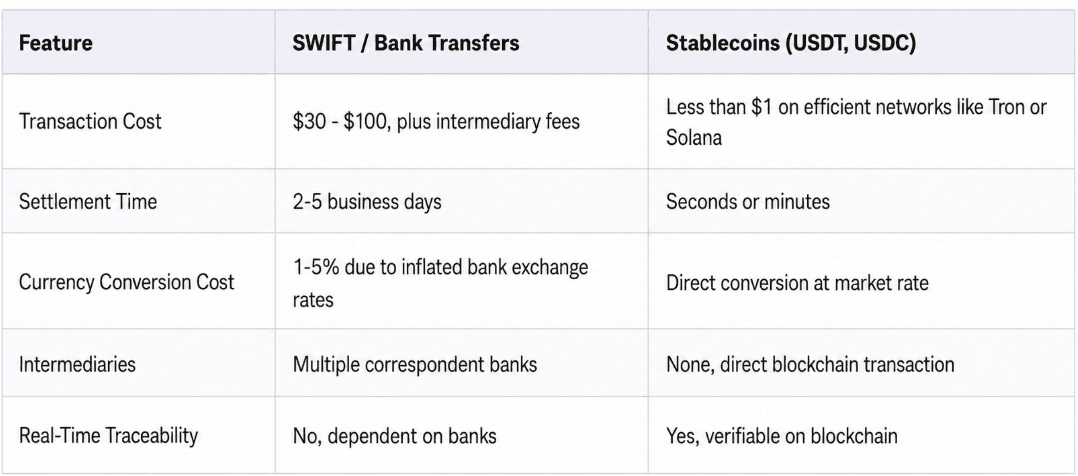
Stablecoins vs Traditional Bank Transfers
How do stablecoins maintain a stable price?
What is a stablecoin peg?
A stablecoin peg is the target price a stablecoin is designed to maintain, usually parity with a fiat currency such as the U.S dollar. To preserve the peg, issuers rely on reserves, economic incentives and smart contracts mechanisms that help absorb volatility and bring the token back to its intended prices when it deviates.
Different types of maintaining parity
Different stablecoins architectures use distinct mechanisms to maintain their peg. The most common structures are:
Fiat-Backed stablecoins
They are backed by cash reserves or equivalent assets. Known examples include stablecoins issued by companies like Tether (USDT) and Circle (USDC). The logic is simple: for every stablecoin in circulation, there is an equivalent value held in reserve.
Asset-Backed stablecoins
Asset-backed stablecoins are supported by reserves of real-world assets. Some are backed by government bonds, commodities or baskets of financial assets, while maintaining the same goal of preserving price stability. In this model, the issuer holds collateral that supports the value of the stablecoins in circulation, allowing users to trust that each token can be redeemed or supported by an equivalent reserve value.
This reserve-based structure is vital for maintaining the peg, as the quality, liquidity and transparency of underlying assets determine how reliably the stablecoin can preserve its value.
The GENIUS Act
The GENIUS Act adds a regulatory layer to how stablecoins maintain their peg. Instead of relying only on market confidence or an issuer’s private promise, the framework requires payment stablecoins to be fully backed by liquid reserves such as U.S. dollars and short-term Treasuries, supported by public reserve disclosures and audit requirements for large issuers. By tying each token’s value to transparent, high-quality collateral, the Act strengthens the redemption mechanism behind the $1 peg: users are more likely to trust that each stablecoin can be converted back into dollars, while regulators can monitor whether reserves are sufficient to absorb redemptions and reduce the risk of destabilizing runs.
Peg Stability in Practice
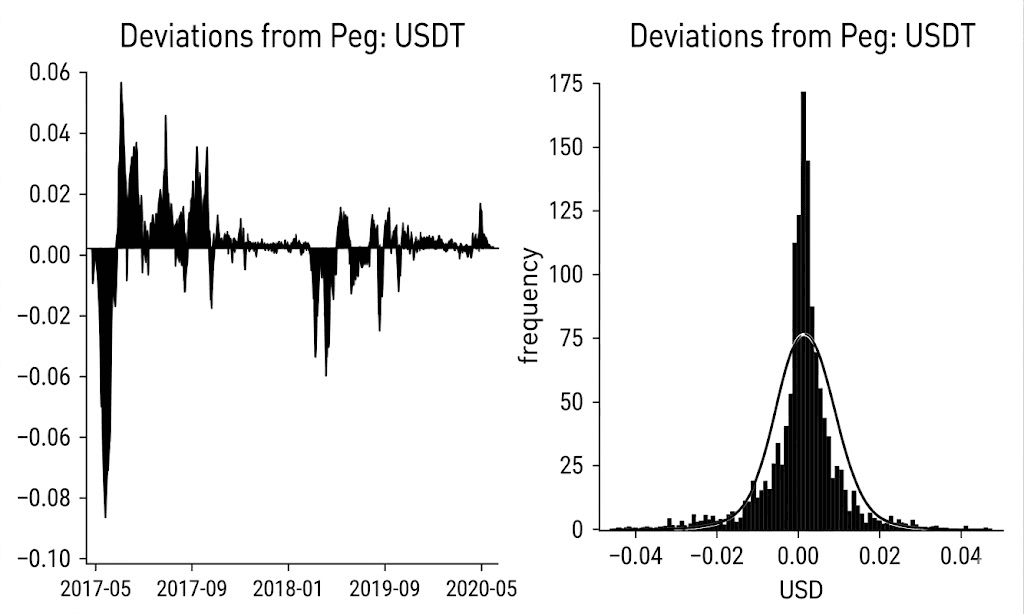
Lyons & Viswanath-Natraj, Journal of International Money and Finance (2023)
USDT usually traded close to its $1 peg, with most deviations clustered near zero. However, larger fluctuations occurred in earlier periods and during moments of market stress. Over time, the peg appears to have become more stable, likely reflecting better liquidity, stronger arbitrage mechanisms, and greater market confidence.
How business use stablecoins

Stablecoins have evolved into core infrastructure for international business payments. As digital commerce expands and companies demand faster, cheaper, and more efficient ways to move money, stablecoin adoption is likely to keep growing, especially among importers, exporters, fintechs, and globally operating businesses. Today, companies use stablecoins not only to transfer value, but also to hold liquidity, settle transactions, and reach customers in markets where traditional payment rails are slow, expensive, or difficult to access.
Cross-Border payments
International payments are often slow, expensive, and unreliable, especially for smaller businesses or companies operating in markets with limited banking access. Stablecoins offer a more efficient alternative: they move 24/7, settle in minutes, and remove the need for correspondent banks. For example, a U.S. company can pay a freelancer in Argentina using USDC, with funds arriving almost instantly and without traditional wire fees or unnecessary currency conversion costs.
Unblockpay is available in over 40 countries, providing access for businesses to offer stablecoins to their customers.
Supplier and contractor payments
Businesses increasingly work with suppliers, freelancers, and contractors across different countries, but traditional payment rails can make these relationships inefficient. Stablecoins allow companies to pay global partners quickly, transparently, and with fewer intermediaries. This is especially valuable in markets where banking access is limited or international transfers are expensive. UnblockPay helps businesses simplify these flows by enabling stablecoin payments that settle faster and are easier to track.
Treasury and cash management
Stablecoins can also improve how businesses manage liquidity. Instead of relying only on bank accounts and traditional settlement windows, companies can hold dollar-equivalent value and move funds across markets, wallets, and platforms 24/7. This gives finance teams more flexibility to manage working capital, respond to payment needs, and reduce idle cash across jurisdictions. UnblockPay supports this by helping businesses access stablecoin infrastructure for faster and more flexible treasury operations.
Settlement and reconciliation
Settlement delays create operational friction for businesses, especially when payments move across borders or involve multiple financial intermediaries. Stablecoins can reduce these delays by enabling near-instant settlement and transparent transaction tracking on blockchain networks. This improves reconciliation, reduces uncertainty, and gives businesses better visibility over their payment flows. Through UnblockPay, companies can integrate stablecoin-based settlement into their operations and make financial processes more efficient.
Access to dollar liquidity
In many markets, access to U.S. dollars can be slow, expensive, or restricted. Stablecoins provide a digital dollar alternative that businesses can use for payments, liquidity management, and international transactions. This is particularly relevant for companies operating in emerging markets or serving customers with limited access to traditional dollar rails. UnblockPay helps bridge this gap by giving businesses a way to offer stablecoin-based access to dollar liquidity across more than 40 countries.
How Unblockpay can help business
UnblockPay provides a global stablecoin infrastructure that helps businesses move between digital dollars and local money faster, more efficiently, and at scale. Through a simple API or Dashboard, companies can enable stablecoin pay-ins, payouts, wallets, on/off-ramps, and local settlement across global markets.
UnblockPay can help you:
Optimize your cross-border payment infrastructure:
Move money 24/7 using stablecoins, with fast settlement and access to local payment rails such as Pix, SEPA, SPEI®, and US Wire.
Expand globally with stablecoin rails:
Reach customers, suppliers, and partners in more than 40 countries by connecting stablecoins to local currencies and payment networks.
Enable stablecoin wallets and digital dollar accounts:
Offer customers access to USDC and USDT wallets, allowing them to save, receive, and move digital dollars across supported networks.
Simplify pay-ins, payouts, and merchant settlements:
Accept and send stablecoin payments without requiring businesses or end users to manage crypto complexity directly, while settling transactions locally.
Build faster with developer-first infrastructure:
Integrate stablecoin payments through a powerful API, real-time webhooks, transaction tracking, and no-code tools for finance and operations teams.
Learn more about how UnblockPay can help businesses build global payment products powered by stablecoins, or book a demo to get started.